
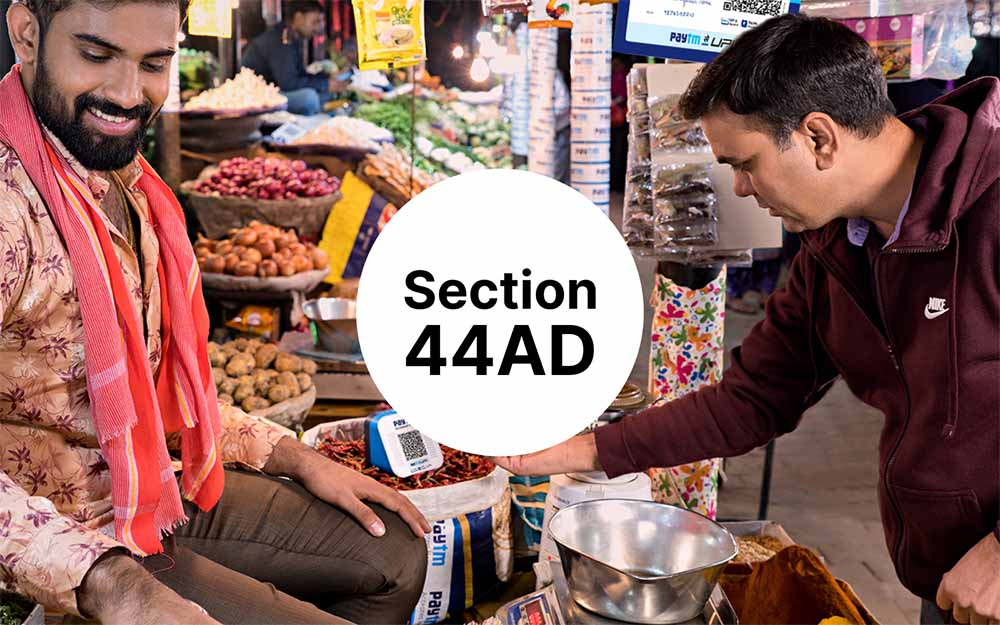
When it comes to managing taxes for small businesses and professionals, understanding Section 44AD of Income Tax Act is essential. This provision is part of India’s broader direct tax code, designed to simplify tax compliance for eligible taxpayers. If you have a small business or trade, this section can significantly affect how much tax you pay and how you report your income to the authorities.
Today, many taxpayers struggle to keep up with complex tax rules. The direct tax code and sections like 44AD aim to reduce this burden by offering straightforward methods to calculate income. Let’s explore how this provision impacts your tax liability, what it offers, and who can benefit from it.
What is Section 44AD of Income Tax Act?
Section 44AD of Income Tax Act provides a presumptive taxation scheme for small taxpayers, mainly small businesses and professionals whose turnover does not exceed Rs. 2 crore. Under this rule, your income for tax purposes is presumed at 8% of your total turnover or gross receipts. This means, rather than maintaining detailed books of accounts, you can simply declare an income equal to 8% of your business turnover, and pay tax on that amount.
Eligibility criteria
– The business turnover or gross receipts should not exceed Rs. 2 crore in a financial year.
– It applies primarily to businesses (not professionals), like traders, shop owners, commission agents, and manufacturers.
– Professional service providers such as doctors, lawyers, and architects are generally not eligible under this section.
– The taxpayer should not opt for the presumptive scheme under any other sections (like 44AE or 44ADA).
– The taxpayer should not carry out business through a partnership firm, company, or LLP. Individual or HUF (Hindu Undivided Family) taxpayers are eligible.
An essential point is that you cannot claim expenses separately as your income is presumptive. This simplifies your bookkeeping but may not always be ideal if your actual expenses are high.
How Section 44AD simplifies tax compliance
One of the main reasons Section 44AD is popular among small business owners is the reduction in compliance burden. Without this section, you would maintain detailed books, get them audited if turnover crosses Rs. 1 crore (or lower thresholds if applicable), and calculate your actual income after expenses. This process can be time-consuming and expensive.
With this presumptive scheme:
– No need to keep detailed books or accounts.
– No requirement for a tax audit.
– Income calculation is straightforward and time-efficient.
– Helps reduce the cost of tax compliance.
For many small traders operating on thin margins, this section saves time and effort, allowing them to focus on their business.
Impact on your tax liability
Since your income is assumed at 8% of your turnover under Section 44AD, this determines your tax base. The actual profits you earn might be less or more than this 8%. If your actual profits are higher, it’s profitable to use this section and avoid complex tax calculations. However, if your expenses are exceptionally high, your taxable income could be inflated under this scheme.
The tax slab rates applicable to individuals and HUFs apply to the presumptive income. So, after calculating 8% of your turnover, you pay taxes as per your income slab.
Advantages for tax liability
– Reduces possibility of under-reporting income, as the government assumes a fixed profit margin.
– Avoids penalties for non-maintenance of detailed accounts.
– If your actual income is underestimated, you can still declare higher income than 8% and pay taxes accordingly.
Drawbacks
– Loss of benefit on actual high expenses as you cannot claim them separately.
– If actual profits are less than 8%, you end up paying more tax than you should.
Who should opt for Section 44AD
Not every small business should automatically choose this scheme. You should consider:
– Whether your turnover is below Rs. 2 crore.
– If your actual profit margin is at least close to or above 8%.
– The extent to which you want to avoid detailed accounting or audits.
– Your business structure — individuals or HUFs can opt, but companies cannot.
For example, if you run a small stationery shop with a turnover of around Rs. 1 crore and your expenses are low, selecting Section 44AD would simplify tax filing and reduce compliance risk. However, a small restaurant with high utility and raw material costs might find it less beneficial.
Relation to the direct tax code reforms
The direct tax code aims to modernise and streamline taxation in India. Section 44AD fits well within this vision by providing a presumption-based simpler compliance model for small taxpayers. Though the direct tax code has not completely replaced existing laws yet, sections like 44AD showcase the government’s intent to ease tax burden on the informal and small sectors.
Simplified procedures empower small traders and entrepreneurs, helping them remain compliant without facing undue complexity. This aligns with broader economic goals of boosting small business growth and formalising the economy.
How mutual funds and small business tax benefits connect
Mutual funds, especially those meant for small investors, often encourage savings and investment. If you run a business and opt for Section 44AD, the simplified tax compliance can free up time to focus on better financial planning. You can invest the tax-saving or surplus funds into mutual funds to build wealth over time.
Additionally, mutual fund investments themselves come with various tax benefits under sections like 80C. When managing small business income under Section 44AD, smart investment in mutual funds can complement your tax planning strategy, ensuring efficient wealth growth and tax liability reduction.
How to file taxes under Section 44AD
Filing taxes under this section does not differ much from regular filing but you need to declare the presumptive income:
– Compute 8% of your total turnover or gross receipts.
– Declare this as your business income in the income tax return.
– Pay tax as per your slab rate on this income.
– Keep proof of turnover like sales bills, receipts, etc., for tax verification, but detailed accounts are not mandatory.
If your turnover exceeds Rs. 2 crore, you have to switch to normal provisions, maintain books, and possibly get an audit done.
Conclusion
Understanding Section 44AD of the Income Tax Act is important for any small business owner or trader who seeks simplicity and relief from complex tax procedures. This section can lower your compliance burden and offer a straightforward way to calculate tax liability. However, it requires an honest declaration of turnover and understanding whether your business fits the prescribed eligibility.
The direct tax code aims to bring more clarity in taxation, and presumptive schemes like 44AD highlight how policy supports economic activities at the grassroots. Using this scheme alongside smart investments in mutual funds can improve both tax efficiency and financial health. Always consult a tax expert to assess your specific circumstances before opting for Section 44AD. Ensuring compliance while optimising your tax liability is crucial for sustainable business growth.